


The story of the Orkney Islands Vikings is a compelling saga of settlement, power, and cultural transformation at the crossroads of the North Atlantic. For over 600 years, these islands off the coast of Scotland were not a remote outpost but a strategic heart of the Norse world. The arrival of Viking longships in the late 8th century fundamentally reshaped Orkney’s identity, weaving a Norse legacy so deep that it remains vividly alive in the landscape, language, and people today. This is a history written in runes, etched into stone, and celebrated in story.
Orkney: The Strategic Norse Stronghold
The geography of Orkney is the key to its Viking age destiny. Positioned between mainland Scotland and Norway, this archipelago commanded the vital sea lanes connecting Scandinavia with the British Isles, Ireland, and the wider Atlantic. When Vikings came west seeking new lands, Orkney offered more than a raiding base; it provided sheltered harbors, fertile farmland, and a perfect launchpad for further expansion. By the 9th century, what began as seasonal raids evolved into permanent Viking settlers establishing a Norse earldom that would endure for centuries.
Control of the islands meant control of trade and military power. Orkney Islands Vikings facts are revealed through remarkable archaeology: the outlines of Norse longhouses, distinctive soapstone artifacts, and rich boat burials that speak of a society deeply connected to the sea. This strategic importance made Orkney a center of Norse political power rather than a peripheral colony. To truly grasp this layered history, many visitors start with Orkney Day Tours, which provide essential context for how the Viking story fits into Orkney’s millennia spanning timeline.
Orkneyinga Saga: The Chronicle of Norse Earls
Our most vivid window into this era is the Orkneyinga Saga. This medieval Icelandic narrative is not dry history; it is a sweeping epic of the Norse earls of Orkney, filled with ambition, betrayal, family feuds, and political intrigue. Written in the 13th century, it traces the lineage and deeds of the rulers of the Orkney earldom from the mythical 9th century onwards.
The saga famously links the earldom’s foundation to the Norwegian king Harald Fairhair, a connection later historians see as a political claim to legitimize Norwegian sovereignty. Regardless, the saga paints a detailed picture of a sophisticated Norse earldom. Figures like Earl Thorfinn the Mighty and the tragic martyrdom of St. Magnus come to life, showing Orkney as a wealthy, powerful player in North Atlantic politics. The Orkneyinga Saga is indispensable for understanding how Norse rule was structured, contested, and maintained across the islands.
Viking Heritage Carved in Stone
The Viking heritage of Orkney is not hidden; it is embedded in the very fabric of the islands. From place names to monumental architecture, the Norse imprint is unmistakable. This heritage represents a profound cultural shift from the earlier Pictish inhabitants to a fully integrated Norse society.
The most spectacular symbol of this transition is St Magnus Cathedral in Kirkwall. Founded in 1137 by Earl Rǫgnvald Kali in memory of his martyred uncle, St. Magnus, the cathedral marks Orkney’s firm embrace of Christianity, replacing the older Norse religion. Its Romanesque architecture stands as a permanent testament to the piety, power, and legacy of the Orkney Viking earls.
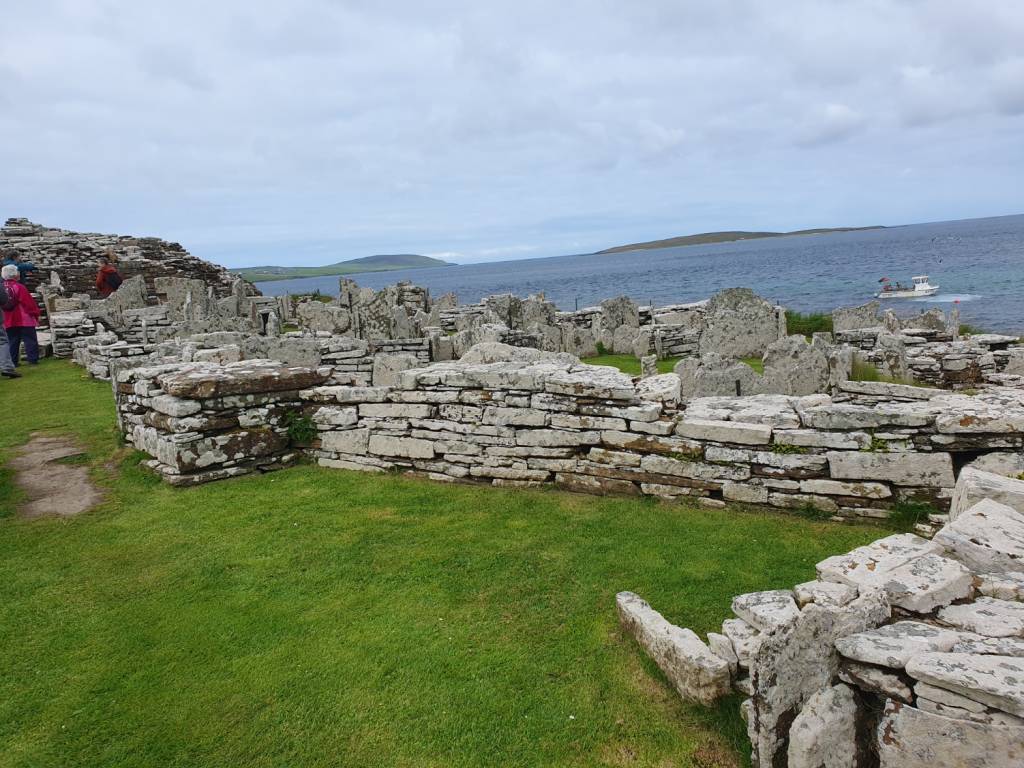
At the Brough of Birsay, a tidal island off the north coast, you can walk among the foundations of a major Norse settlement and an earl’s estate. Here, archaeology and the Orkneyinga Saga converge, revealing a high status political and ecclesiastical center. Further evidence of daily work and livelihoods is found at sites like the Brough of Deerness and Westness on Rousay, where farmsteads and workshops illustrate the blend of seafaring and agriculture that defined Viking Age life.
Norse Influence: Life, Work, and Language
The Norse impact went far beyond stone monuments. It created a new societal fabric. The Viking settlers were not just warriors; they were farmers, fishers, traders, and craftspeople. They established a system of governance, the Orkney earldom, that maintained order and levied taxes, tying Orkney firmly to the crown of Norway.
Everyday life revolved around the seasons: tending barley and oats, fishing the rich seas, and raising sheep and cattle. The work was communal, and society was hierarchical, governed by Norse law, with the Udal laws persisting for centuries. Their language, Old Norse, evolved into the Norn tongue, which was spoken in Orkney until the 18th and into the early 19th century. Most tellingly, nearly every place name in Orkney, from Kirkwall (Kirkjuvágr, ‘Church Bay’) to Skaill (skáli, ‘Hall’), is Norse in origin. This was a population that came to live, thrive, and put down unshakable roots. The depth of this influence makes the History of the Orkney Islands Vikings a central pillar of the islands’ identity.
Heritage Celebrated: From Festival to Modern Identity
Today, the legacy of the Orkney Vikings is a vibrant, living heritage, actively celebrated rather than merely studied. This connection bursts into life during the annual Orkney Island Viking Festival, a week long event in Kirkwall featuring longship races, combat reenactments, crafts, and saga storytelling. It is a powerful, tangible link to the past that reinforces community identity and attracts visitors keen to connect with this Viking heritage.
While the Viking Age defines much of Orkney’s medieval history, it sits upon an even older foundation. The islands are also home to some of Europe’s best-preserved Neolithic sites, like the village of Skara Brae and the Ring of Brodgar. Exploring these pre-Viking wonders, perhaps on a dedicated Skara Brae and Ring of Brodgar tour, offers a breathtaking perspective on the full depth of Orkney’s human story, a narrative spanning over 5,000 years.
For those fascinated by the Norse era, other key sites bring the Orkney Viking past into focus. Maeshowe chambered cairn, a Neolithic tomb, was broken into by Norse crusaders in the 12th century. They left behind the largest single collection of runic inscriptions in the world, graffiti that boasts of treasure, jokes, and pure prowess. At the Knowe of Swandro on Rousay, archaeology continues to work, unveiling a settlement sequence from the Iron Age to the Norse. These layers show the transition of power and the practicalities of how Norse settlers chose to live on these windswept islands.
Conclusion: A Legacy That Endures
The saga of the Orkney Islands Vikings is a testament to profound and lasting cultural change. From their first arrivals in the 8th century to 1468, when the islands were pledged to the Scottish crown, the Norse shaped Orkney’s destiny for over half a millennium. They established a powerful Norse earldom, chronicled their deeds in the Orkneyinga Saga, and built a society whose markers, from St Magnus’ Kirk to the very names on the map, define Orkney to this day.
This viking heritage is not a relic but a continuous thread in the islands’ identity. Whether witnessed in the stone ruins at Birsay, felt during the Orkney Island Viking Festival, or traced on a comprehensive orkney day tours, the story of the Orkney vikings remains an immediate and powerful presence. It is a story of how seafarers from Norway came to these islands, made them home, and left an indelible mark that continues to captivate all who explore this unique corner of Scotland. Their history is a foundational chapter, ensuring the Orkney Vikings are remembered not as fleeting raiders, but as the architects of an enduring Norse realm in the North Atlantic.